Properties of Natural Light

Students move outside in the daytime on a sunny, in a circular group to observe the properties of natural light.
Direction
Intensity
Shape
Colour
Movement 

Direction – Primary light source is the sun, DO NOT look directly at the Sun.
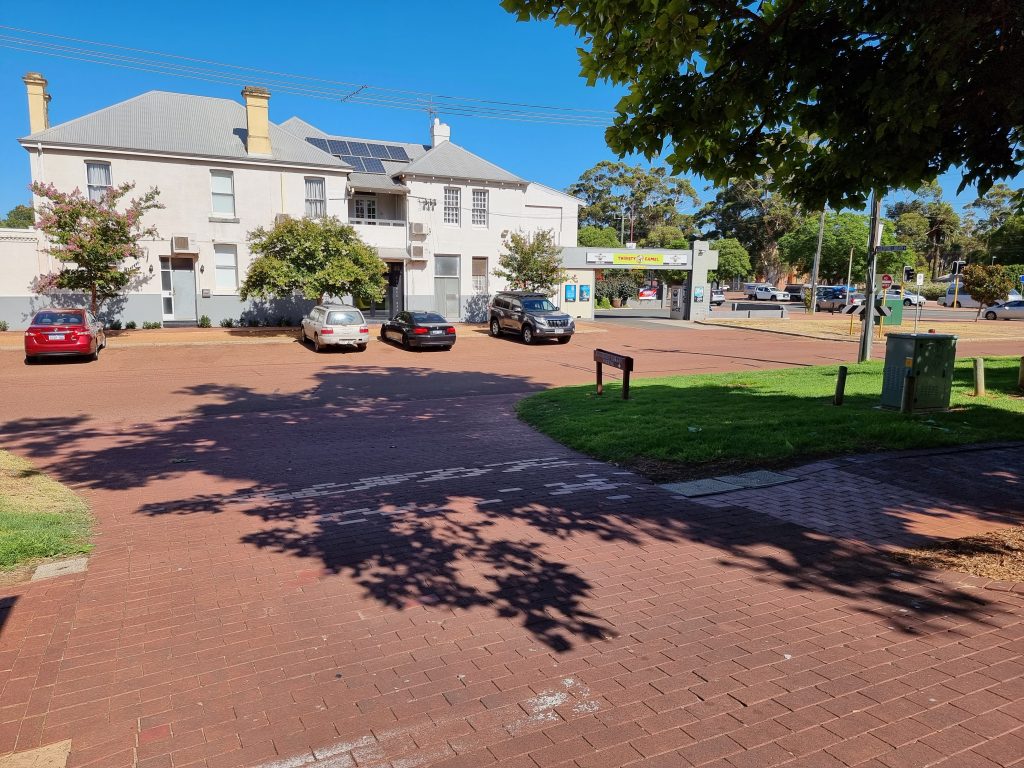
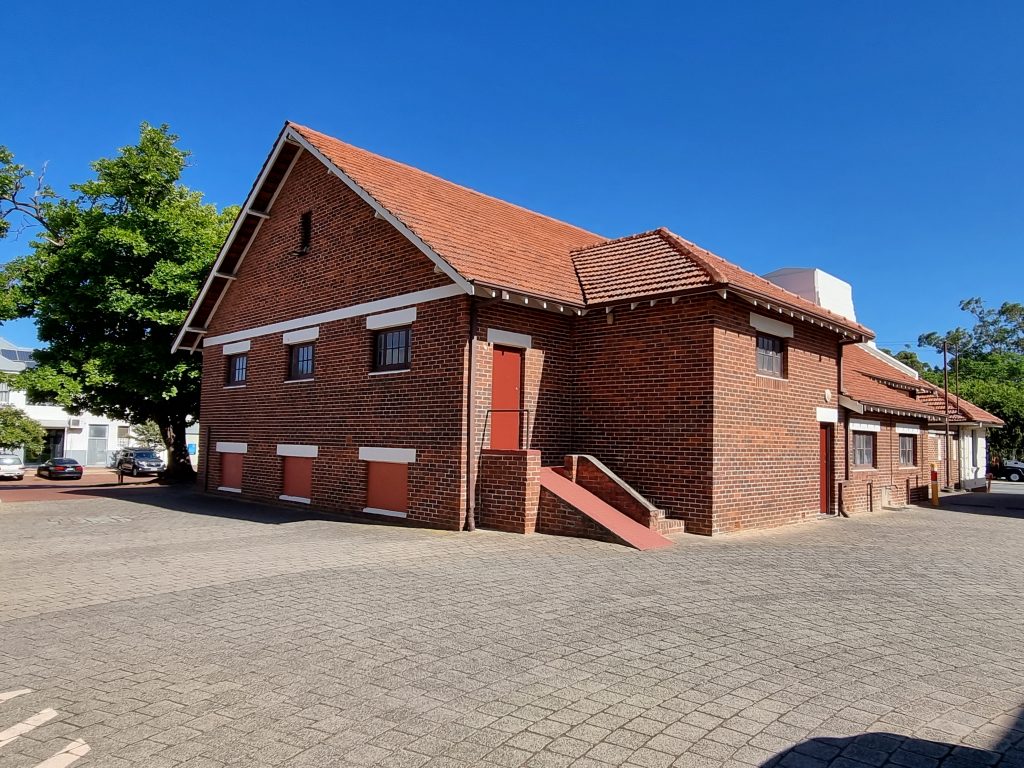
Intensity of the sunlight is dependent of the angle of the sun and atmospheric conditions . It is brightest at midday with no clouds. The East side wall is bright as it is directly lit, the rear South wall is lit by reflected light, so is not as bright.
Shape of the light beam is affected by objects in the path of the light beam. In the pictures, you can see familiar shapes of leaf shadows, most of the light is blocked by the tree. . The light source is full spectrum.
Colour of the light is dependent on how reflective the surface is and the colour of the surface, as most of the light spectrum will be absorbed, except mirrored surfaces.

Exercise
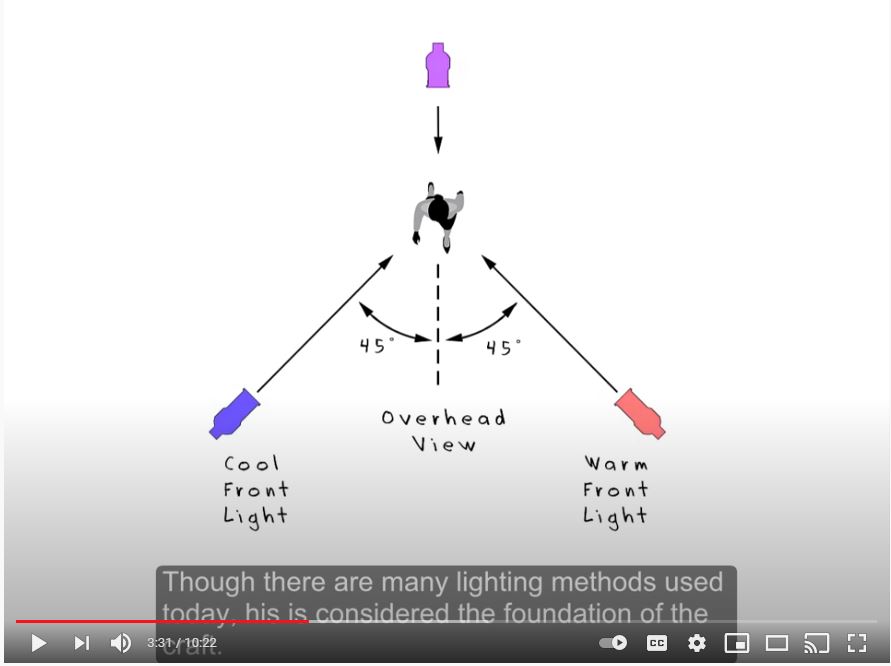
In a circular group, observe what side of a persons face is lit by the sun, how do the shadows look like, the difference in colours between direct and reflective lit areas of the face and body. The direct sunlight is the Warm light and the reflected light the Cool light that McCandless refers to. Using an analog clock face as a reference, observe how the lighting and shading changes as you look around the circle. Get the group to rotate the circle 180 degrees and see how the lighting has reversed. How can this be used on a stage to indicate time of day ?
look at buildings and trees to see the difference between hard shadows of building and softer shadows of trees. Can you see changes in the trees shadows if it is windy.
Explain why the bottom pictures looks different.

McCandless Method
If possible, watch Matt Kizers video The Lighting Design Process https://scenicandlighting.com/article/the-lighting-design-process/ on Youtube, it runs for 10:22 minutes, before doing this workshop.
Get the students to stand at the centre of the nine stage areas, DSL, DSC, DSR, MSL, MSC, MSR, USL, USC, USL. If possible, have them raise their arms up at 45 degrees and spread apart at 45 degrees to see where the Warm and Cool key lights should be. How well do the optimal positions line up with your theatres lighting locations?

Conventional Theatre Lights or Luminaires
These are the different types of conventional lights generally available to us that we can use for theatre lighting, unless your theatre has upgraded to LED Lighting.

CAUTION
Theatre lamps are fragile and expensive so do not handle with bare hands, make sure that all focus controls move freely and do not jar the fixture.

Floods and Cyc Lights conventional lamps
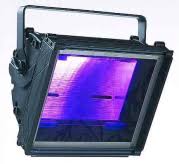
The Flood has a symetrical reflector that produces a bright centre to the beam and reduces in intensity towards the outside edge of the beam. These were one of the earliest mass produced theatre lights.
These are very basic in shape and in general produce a rectangular beam that we have little control over the shape. They have provision for a colour frame to use a lighting filter to change the colour of the beam.
The Cyc or Cyclorama light has an asymetrical reflector that reflects most of the light downwards, so that when it is mounted at the top of the cyclorama, the intensity of the light is even from top to bottom of the cyclorama. acclaim-cyc_data
The top Flood is a Strand Patt 137 150W halogen flood with an ES or Edison Screw base lamp. Patt 137 Datasheet
The bottom Cyc Light is a Selecon LUI 1000W tungsten halogen flood using a linear lamp. Lui Cyc Datasheet

Fresnels and Pebble Convex Lights
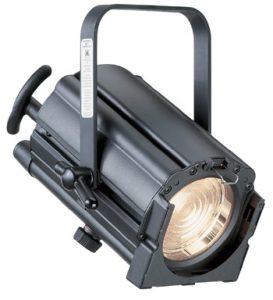
The lens of the fresnel was invented for use in lighthouses to provide an soft edged beam, which makes it suited for most acting areas, as there is no noticeable change in intensity when an actor moves around the stage in a correctly focused lighting rig. The beam size is adjustable, usually from about 10 degrees to about 60 degrees.
The fresnel lens is stepped on the outside and lightly pebbled on the inside.
Because a fresnel lens produces some light scatter, they are usually fitted with barndoors


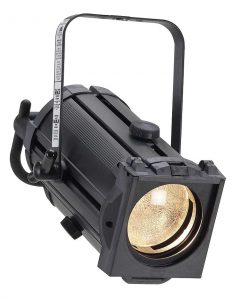
The Pebble Convex light has lots of small dimples on the outside of the lens that produce a semi hard edge beam with less scatter than a fresnel. These were popular for sidelighting as they are a cross between a fresnel and a profile.Acclaim_Fresnel and PC Operation and Data sheet

Profile Spots

These produce a hard edged beam that can be easily shaped to restrict the light beam to a specific area such as the proscenium arch of a stage, or a doorway or a window. 

Why Use Profiles For Downstage Lighting

Natural light has an even intensity with no hot spots or dark patches when measured with a light meter in an open area with no shadows.

To achieve the same even intensity across the width of the stage requires the use of a light source that interacts with adjacent lights to achieve this even intensity.

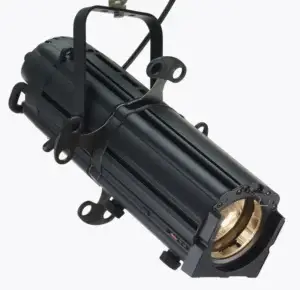
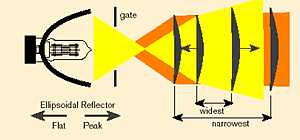
A good quality Zoom Profile such as a Selecon Acclaim zoom profile has a lamp adjustment to provide PEAK  or  FLAT  intensity of the light beam.
The PEAK intensity is used for acting area lighting so the intensity of the light is 50% at the sides of the beam, so where  adjacent profile beams overlap, the sum of the two light beams is 100% to give an even intensity across the stage,to achieve natural lighting 

The FLAT adjustment is for use with gobos for an even intensity across the light beam for realism of the projected shape to achieve natural lighting.

Using a Zoom Profile allows for different beam widths required for different angles of the outside rigging positions, where the optimal 45 degrees of the McCandless Method cannot be obtained. The shutters of the Zoom Profile are used to shape the beam for no spill outside the proscenium arch

This example from Light Shining In Buckinghamshire shows the minister highlighted in Middle Stage Centre using the shutters in a profile spot to create a tight rectangle and two Chancery church window gobos to place the actors in a church.

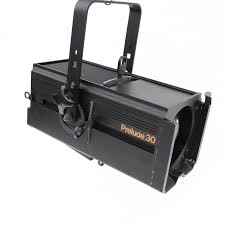
In a  Profile Spot the plano convex lens can be moved to focus the beam. A common example in local theatres was the Strand Prelude 30 500/650W Profile. prelude30datasheet

A later development is the Zoom Profile that has two lenses to allow the beam angle or size to be varied as well as the focus.
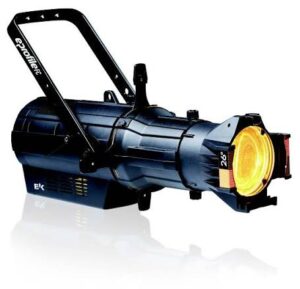
Profiles usually have shutters fitted to allow the beam shape to be varied, such as changing it to a rectangular shape to light a doorway. The Selecon Acclaim Zoom Profile is available as  650W GY9.5 base version or the more efficient Axial Acclaim Zoom Profile that is as bright as most conventional 1000W profiles

acclaim_axial_zoomspot_MKII Data sheet
A gobo can be fitted into a profile gate to allow for projection of a shape, such as a window or a leaf breakup.
The size of a profile beam can be adjusted by fitting an iris into the profile in the gate.

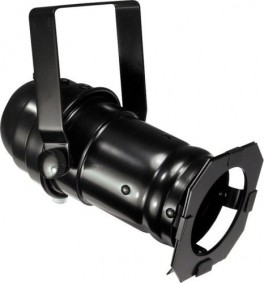
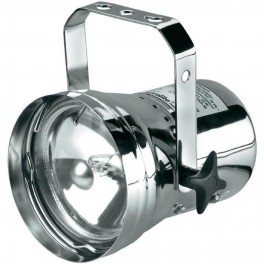
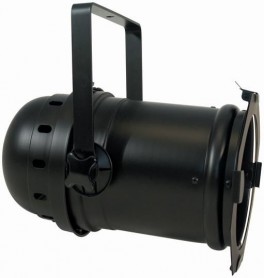
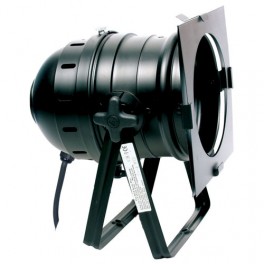
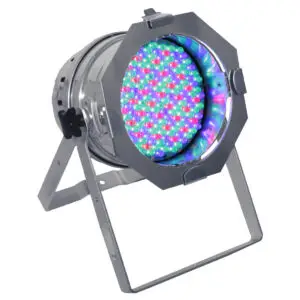
PARCAN’s which got their name from the one piece glass lamp with a Parabolic Aluminised Reflector was the workhorse of the rock and roll industry lighting because of the bright light source that allowed for strong saturated colours,

PAR 16 Birdie has a seal beam lamp 16 x 16″ or 2 inch diameter. it is available in short nose or stubby and long nose. Short nose is useful as foot lights and for concealing lighting in a set. Long nose is useful as small specials. The sealed beam lamps are usually 12V as the 240V version is succeptable to filament damage when used as a foot light. Beam sizes for 12V are 10, 16, 24, 38, 50, 60 degrees.


PAR 36 Pin Spot has a sealed beam lamp 2 1/4 ” diameter and a narrow beam angle of 5 degrees which makes it ideal for lighting mirror balls and wedding table centre pieces.


PAR 56 has a sealed beam lamp of 3 1/2″. It has an oval beam shape and is available in three beam angles, Wide Flood which has a lenticular lens with more rows or shorter rectangles, beam angle of 18 x 37 degrees, Medium Flood which has a lenticular lens which are rows of long rectangles, beam angle of 11 x 23 degrees, Narrow Spot which is textured fuzzy finish, beam angle of 8 x 10 degrees.


PAR 64 has a sealed beam lamp of 8″. It has an oval beam shape and is available in four beam angles, FFS or Wide Flood which has a lenticular lens with more rows or shorter rectangles, beam angle of 24 x 48 degrees, CP62 (FFR) or Medium Flood which has a lenticular lens which are rows of long rectangles, beam angle of 11 x 24 degrees, CP61 (FFP) or Narrow Spot which is textured fuzzy finish, beam angle of 11 x 14 degrees, CP60 (FFN) or Very Narrow Spot has a clear lens, beam angle of 9 x 12 degrees.


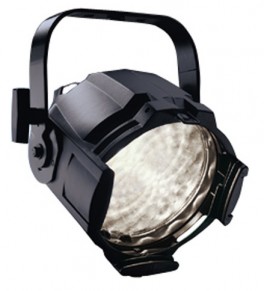
Source 4 PAR does not have a sealed beam lamp, they use a 575W HPL lamp which is comparable to a 1000W PAR lamp. The have four interchangeable lenses: VNSP, NSP, MFL, WFL.